.svg "EPMware")

EPMware's governance model enables a structured, repeatable audit process that provides reassurance across the organization.

EPMware
Software
In large global enterprises, transformation is often associated with new systems, new dashboards, and new analytics. But sometimes the most important transformation is far less visible. It happens inside the control framework. It shows up in audit reviews. It reveals itself in governance maturity.
For a leading global mining organization, that transformation centered on a critical but often overlooked domain: metadata governance within its Oracle EPM landscape.
The organization’s finance systems team was responsible for administering core financial platforms, including Hyperion Financial Management (HFM), Planning, and related consolidation tools. Like many global enterprises, they had historically relied on a combination of EPMA, Excel templates, and manual processes to manage metadata changes. Those processes had worked for years. They enabled deployments, supported dimension updates, and kept the business running.
But they did not deliver control. As one systems leader explained:
"We could make some changes [...] but obviously there was no control. There were no workflows as well. We couldn’t run reports and track who initiated the change, peer review, approval [...] The gap was not about technical capability. It was about governance discipline."
The catalyst for change was not a system failure. It was an internal controls initiative. As the organization strengthened its IT general controls (ITGC) framework, metadata governance moved from a “nice to have” to a required control layer.
“The main reason was that we needed strong process management, strong process management controls, which we couldn’t have with the product,” one leader shared.
Auditors required formal workflows. They required segregation of duties. They required traceability and documentation that could withstand scrutiny. It was no longer sufficient to rely on email approvals or manual evidence collection.
The audit requirements were specific and uncompromising. An author of a metadata change could not be the one approving it. The individual approving a deployment could not have unrestricted administrator rights in both development and production environments. Every change needed to be documented, timestamped, and reportable on demand.
The organization understood that Excel would not solve this problem. As one executive put it succinctly, “Excel was never going to be good enough.” What they needed was a governance layer purpose- built for EPM metadata.
When Oracle began rolling back aspects of metadata management capability (i.e., EPMA) within the Hyperion suite, the team reassessed its options. The evaluation was pragmatic rather than theatrical, driven by internal assessment and trusted partner guidance rather than a lengthy RFP cycle.
At this stage, UK-based EPM consultancy AMOSCA played a critical advisory role.
As a specialist Oracle EPM consulting partner with deep implementation experience, AMOSCA helped the organization frame the problem correctly. Instead of viewing the situation as a broad master data challenge, AMOSCA narrowed the scope to what it truly was: financial metadata governance inside complex EPM applications.
AMOSCA provided practical insight into:
The limitations of EPMA in modern control environments.
The realities of financial metadata complexity, including ragged hierarchies and pre-defined aggregation properties.
The differences between enterprise MDM tools and financial metadata governance platforms.
What would realistically meet audit and ITGC requirements without introducing unnecessary architectural overhead.
The key insight was clarity of scope. The organization did not need a costly enterprise MDM platform. It needed targeted governance across its Oracle EPM estate.
One executive described the alternatives bluntly: Some solutions were “a sledgehammer to crack a nut.” They were powerful for traditional MDM use cases but were not purpose-built for financial systems. They lacked alignment with the dimensional logic, hierarchy structures, and consolidation behaviors unique to Oracle EPM.
EPMware aligned with the organization’s requirements at that moment. It delivered structured workflows, approval routing, segregation of duties, deployment control, and audit reporting, without forcing a broader architectural overhaul.
“It was ideal for what we were looking for at that time,” the finance leader reflected.
The decision was not about adding complexity. It was about closing a governance gap with precision.
Once the decision was made, AMOSCA’s role shifted from strategic advisor to implementation partner.
Because AMOSCA deeply understood the organization’s Hyperion landscape, the team was able to translate control requirements directly into practical configuration decisions.
This included:
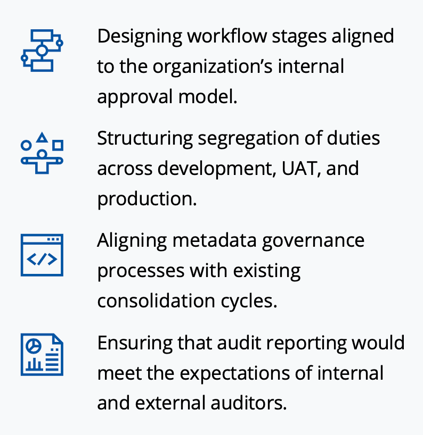
Rather than treating governance as an isolated tool, AMOSCA integrated it into the operational rhythm of the finance systems team.
The result was a governance model that felt embedded rather than imposed.
The implementation did not disrupt financial close cycles. It did not require re-architecting the EPM stack. It layered structured control over existing applications in a way that felt natural to the team administering them.
The impact of the implementation became most visible during audit cycles.
Before EPMware, extracting metadata audit logs from HFM was a tedious process. Documentation was fragmented, evidence collection required manual effort, and end-to-end traceability was difficult to demonstrate. After implementation, the process became structured and repeatable.
Each metadata change was tied to a formal request. Each request was routed through defined approval stages. Each deployment was controlled and timestamped. Every action was logged.
Auditors typically select a sample of change requests, often 20 out of 60-80, and request full traceability. With EPMware, the finance systems team can generate detailed approval reports on demand with date and time stamps. They can also demonstrate documented review and approval history.
“We were able to make one of our ITGC controls effective [...] Auditing and tracking would have been impossible without the new governance model,” the team shared.
Twice a year, formal reports are provided to auditors, and walkthrough sessions are conducted with confidence rather than apprehension. What was once manual and reactive became systematic and defensible. For finance executives, this shift represents more than operational improvement. It represents risk mitigation at the executive level.
As the organization looks ahead, including potential expanded regulatory oversight and possible exposure to SOX frameworks, governance becomes even more strategic.
Leadership has already begun evaluating how existing controls can support enhanced compliance obligations. There is growing awareness that metadata governance, when properly structured, plays a direct role in broader financial reporting integrity.
A finance executive noted:
"It’s reassuring [...] it gives the auditors and our compliance teams the comfort that they need,"
That reassurance matters in boardrooms, merger discussions, and capital market conversations.
This story is not about replacing Oracle DRM, DRG, or EPMA. It is not about implementing a massive data program. It is about clarity of purpose.
The organization identified a specific control deficiency, leveraged trusted EPM advisors to evaluate the right solution, implemented a targeted governance layer, operationalized its ITGC discipline, strengthened its audit posture, and avoided unnecessary architectural sprawl.
In the words of one executive:
"If it’s software that makes the job easier for my team, then I’m fully supportive of it."
For finance and EPM leaders navigating modernization efforts, the lesson is straightforward.
Governance gaps rarely announce themselves loudly. They surface during audits, appear during regulatory transitions, and expose risk in moments of scrutiny.
The most resilient organizations do not wait for that moment.
They build control frameworks intentionally. They align technology with governance objectives. They choose precision over excess. And they treat metadata not as a technical detail, but as a foundational component of financial integrity.
In doing so, this global mining leader transformed a quiet operational vulnerability into a durable governance advantage.
EPMware stands out in the marketplace by combining metadata management and data governance capabilities in a single, intuitive platform. EPMware has built-in application intelligence, so the process of managing hierarchies and data governance is seamless, creating dimensional consistency across all subscribing applications.
Designed by financial systems consultants with decades of implementation experience, EPMware brings effortless metadata management back to the business. Out-of-the-box, plug-and-play adapters allow for rapid implementation and configuration to supported applications, including:
OneStream
Oracle on-premises and Cloud EPM
Oracle E-Business Suite (EBS)
Oracle Fusion
SAP ECC & S4/HANA
And more